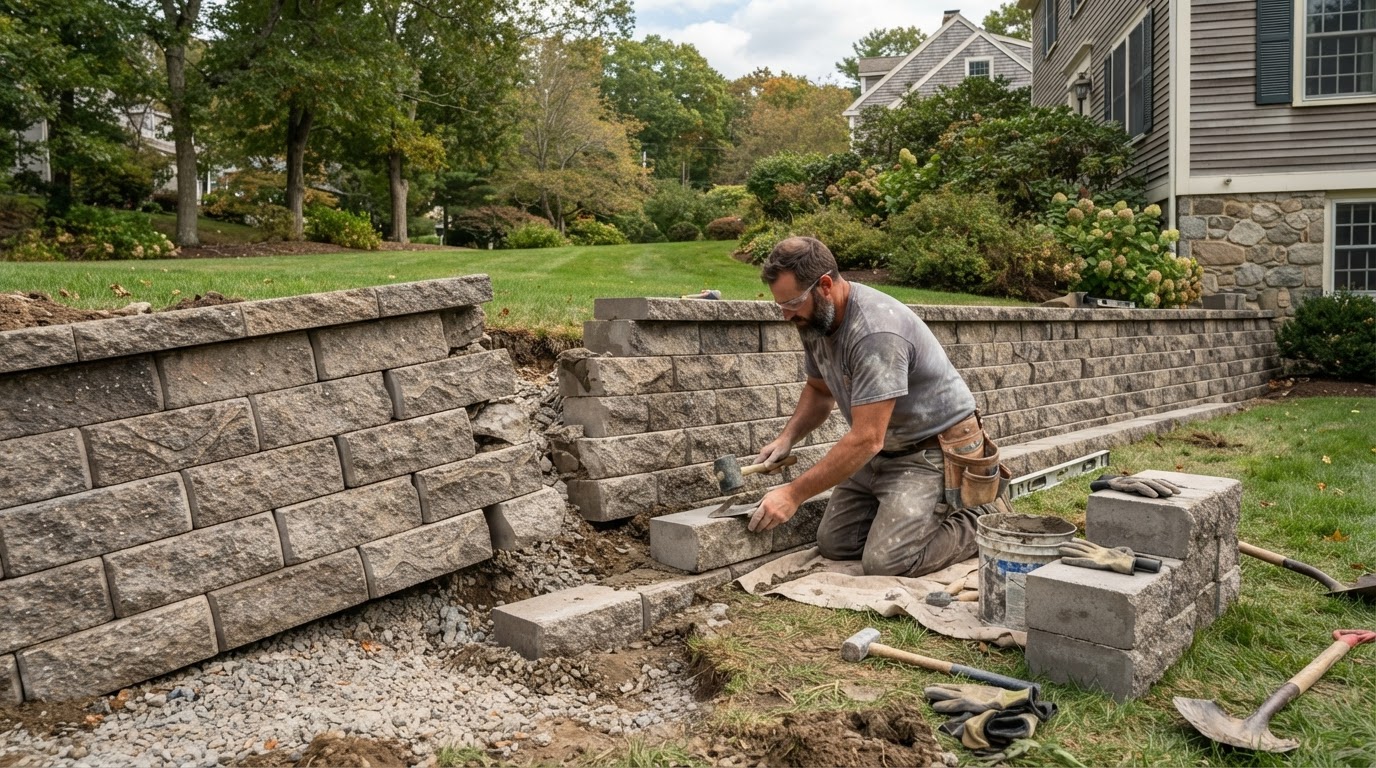
Retaining Wall Repair in Milford, MA | 10+ Years Experience
Milford Masonry Pros repairs residential masonry retaining walls in Milford, Massachusetts where walls show leaning, bulging, settlement, displaced units, failed joints, drainage problems, or localized deterioration. With 10+ years of hands-on experience and insured service, we evaluate the cause of wall distress before recommending repair — because retained soil pressure and trapped water can make superficial patching ineffective.
Retaining-wall symptoms should be evaluated for their cause, because drainage, base, grade, wall height, material type, and reinforcement system all shape the repair problem. We differentiate repairable localized conditions from walls that may require substantial rebuilding, and we explain when tall, heavily loaded, or structurally significant walls may require professional design and permit review. We do not provide excavation or reinforcement DIY instructions.
Why Choose Milford Masonry Pros for Your Masonry Project?
10+ Years Experience
More than a decade of hands-on retaining wall repair across Milford and surrounding Massachusetts communities, covering segmental block, natural stone, and concrete masonry walls.
Insured
Milford Masonry Pros carries insurance so your property and project are protected while retaining wall repair work is underway.
Cause-First Evaluation
We evaluate drainage, base, retained soil, and wall geometry before recommending repair, so the scope targets the reason for movement rather than visible cracks alone.
Drainage and Base Awareness
We understand that hydrostatic pressure from trapped water is a leading cause of wall failure, and we include drainage correction in scope where the wall requires it.
Experience With Masonry and Segmental Wall Systems
Familiarity with segmental retaining-wall block, natural stone, and concrete masonry, including base course, wall batter, and reinforcement considerations.
Clear Repair-vs-Rebuild Guidance
We explain when a localized repair is sufficient and when substantial reconstruction is the safer choice, so the scope matches the actual condition.
Transparent Pricing
You see defensible market ranges up front with the real price drivers named, and a written estimate after evaluation — no pressure to commit on the spot.
Permit and Design Awareness
We explain when tall, heavily loaded, or structurally significant walls may require professional design and permit review through Milford Building & Inspections.
Our Specialized Retaining Wall Repair Services
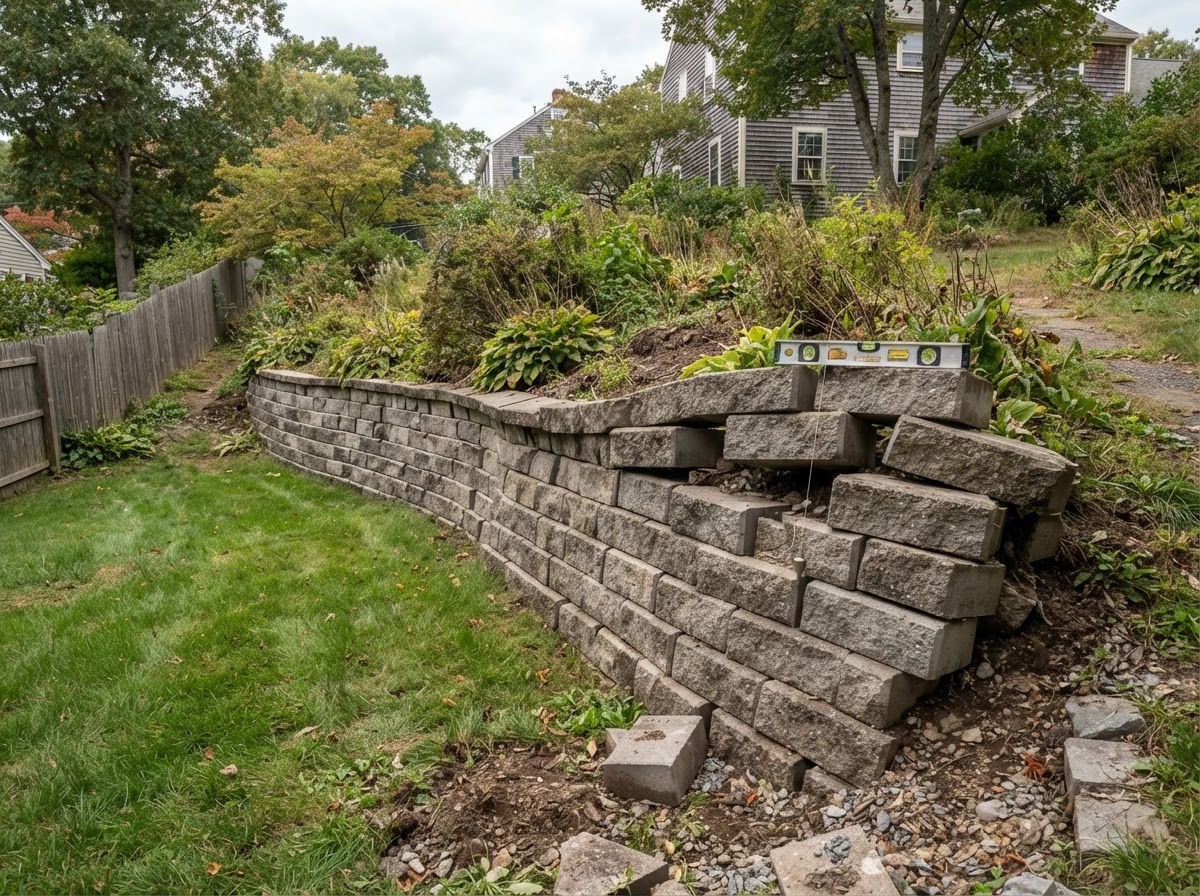
Leaning Retaining Wall Repair
Leaning retaining wall repair evaluates and repairs walls that have developed visible lean due to movement, base problems, soil pressure, drainage issues, or localized construction failure on Milford properties. It applies to segmental block, natural stone, and concrete masonry retaining walls.
The repair evaluates wall material, height, alignment, base condition, drainage, retained soil conditions, and whether localized dismantling and rebuilding is feasible. The cause of the lean is identified before any reconstruction so the repair addresses the pressure or drainage problem driving the movement.
The repair scope targets the reason for movement rather than simply covering cracks or forcing displaced units back into place, reducing the chance of repeat failure.
Bulging or Displaced Wall Repair
Bulging or displaced wall repair addresses outward bulges, shifted blocks or stones, opened joints, and localized displacement on Milford retaining walls. It applies where a section of the wall has pushed out under load but the rest of the wall may still be stable.
The repair determines whether retained soil pressure, trapped water, missing or failed drainage, base settlement, or reinforcement conditions contribute to the failure before rebuilding the affected sections. The wall system, drainage, and alignment are considered together during reconstruction.
Failed portions are reconstructed with the wall system, drainage, and alignment considered together, restoring the section as part of a functioning retaining structure.
Drainage-Related Retaining Wall Repair
Drainage-related retaining wall repair addresses walls showing deterioration associated with water buildup, washed-out material, erosion, staining, or repeated movement after wet weather. It applies to Milford retaining walls where trapped water is driving the failure.
The repair evaluates drainage aggregate, water pathways, outlets, surface runoff, backfill, and repair access to identify where water is building up behind the wall. Drainage corrections are included in scope where the wall requires them, without providing a DIY drainage installation recipe.
The masonry repair is paired with the drainage corrections included in scope so water pressure is not ignored, addressing the most common cause of retaining wall failure.
Localized Retaining Wall Rebuilding
Localized retaining wall rebuilding rebuilds failed wall sections when units, stone, joints, base, or alignment are too compromised for simple localized patching. It applies to Milford retaining walls where a section has failed beyond spot repair but the larger wall is salvageable.
The work involves controlled dismantling to stable limits, base reconstruction, unit or stone replacement or reuse where appropriate, drainage-system work, and reinforcement only as required by the approved wall design or system. The rebuilt section is integrated into the existing wall line.
The failed section is rebuilt as part of a functioning retaining system rather than treated as a decorative wall repair, with base and drainage restored to support the load.
Common Causes of Retaining Wall Problems
Inadequate or Failed Drainage
Inadequate or failed drainage is the most common cause of retaining wall failure, because trapped water builds hydrostatic pressure behind the wall. Without free-draining aggregate and proper outlets, even a well-constructed wall can be pushed out by water-saturated soil.
Base Settlement
Base settlement allows the wall to drop or tilt as the compacted aggregate base beneath it moves. An undersized or poorly compacted base cannot support the wall's load and leads to settlement cracks and alignment loss over time.
Excess Soil or Surface-Water Pressure
Excess soil or surface-water pressure from surcharge loads, steep slopes, or runoff directed behind the wall increases the lateral force beyond what the wall was built to hold. The wall responds by leaning, bulging, or displacing at its weakest point.
Freeze-Thaw Movement
Freeze-thaw movement shifts the wall and its base as moisture in the soil and drainage aggregate freezes and expands through Massachusetts winters. Walls with trapped water are especially vulnerable to frost-driven displacement.
Improper Wall Geometry or Reinforcement for the Load
Improper wall geometry or reinforcement for the load means the wall was built without the batter, height, or reinforcement its soil conditions require. A wall built beyond its effective height or without needed geogrid cannot resist the lateral pressure and fails over time.
Signs You Need Retaining Wall Repair in Milford
Visible Lean
A visible lean means the wall has shifted out of plumb under lateral pressure, often from trapped water or base failure. Prompt evaluation can determine whether a localized repair will correct the lean before it worsens.
Outward Bulging
Outward bulging indicates that soil and water pressure has pushed the wall face out at a weak point. A bulge often signals drainage failure behind the wall that should be addressed before rebuilding.
Separated or Displaced Blocks/Stones
Separated or displaced blocks and stones mean the wall units have shifted out of alignment, often from movement or joint failure. Resetting or rebuilding the affected section restores the wall's continuity.
Settlement Along the Wall
Settlement along the wall shows as dips or steps in the wall line where the base has dropped. Settlement often points to base or drainage problems that should be corrected during the repair.
Water or Soil Washing Through the Wall
Water or soil washing through the wall means drainage material is escaping and the wall is losing its backfill support. This is a sign of failed drainage that will lead to larger movement if not addressed.
Recurring Cracks After Prior Patching
Recurring cracks after prior patching mean the underlying cause was not addressed and the wall is still moving. Sudden or significant movement deserves prompt professional evaluation without scare language — early action can prevent a total failure.
Our Retaining Wall Repair Process
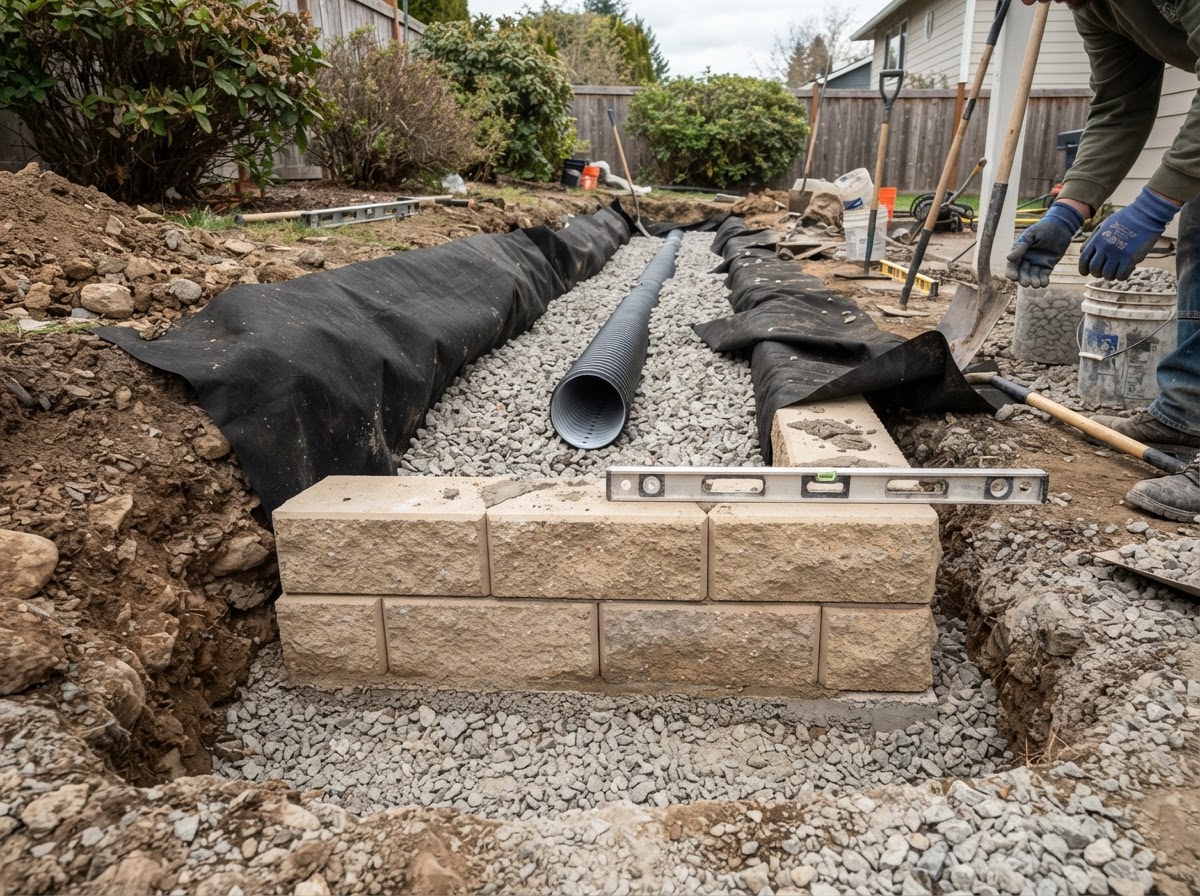
Assessment and Planning
We evaluate wall type, dimensions, slope and grade, retained soil, visible movement, drainage, base condition, surface runoff, access, and nearby loads. The assessment identifies whether masonry repair alone is appropriate or whether professional design or permit review may be needed.
Preparation and Repair Scope
We define the stable repair limits, materials to reuse or replace, excavation and access needs, drainage work, base reconstruction, and any wall-system components required by the project. The scope is documented before any dismantling begins.
Repair or Rebuilding
We carry out the approved localized repair or rebuild using appropriate base preparation, wall units or stone, drainage components, alignment, and reinforcement only where the wall design or system requires it. The work follows the documented scope rather than expanding unnecessarily.
Finishing and Quality Control
We restore specified backfill and grade transitions, check wall lines and drainage details, remove debris, and conduct a final walkthrough. The review confirms the wall is stable, drainage is functioning, and the site is clean.
How Much Does Retaining Wall Repair Cost in Milford, MA?
Small localized retaining wall repairs: about $1,000 to $3,000
Notes: Limited displaced units, access, minor base work, and localized drainage corrections define many smaller scopes.
Partial retaining wall rebuilding: about $2,500 to $8,000+
Notes: Wall length/height, excavation, demolition, base reconstruction, wall material, drainage, equipment access, and disposal affect cost.
Substantial retaining wall reconstruction: often $5,000 to $20,000+
Notes: Long/tall walls, major excavation, engineered reinforcement needs, complex grades, difficult access, material replacement, and drainage systems can push costs higher.
Segmental wall repair/rebuild: often roughly $40 to $100+ per square foot of wall face
Notes: Height, base, backfill, drainage, reinforcement, block system, access, and site conditions materially affect unit pricing where major reconstruction is required.
Ranges reflect typical Milford-area market conditions and are provided to help you plan. Your written estimate will reflect your specific property, materials, and scope.
These are market guidance ranges, not binding quotes. Large or structurally significant walls may exceed them, and engineering, design, or permitting — when required — may be separate or additional. Your written estimate reflects your specific property and scope.
Get Your Retaining Wall Repair Estimate
Tell us about your Milford-area masonry project and we'll follow up with a clear next step.10+ Years Experience · Insured.
Call 508-458-8256Frequently Asked Questions About Retaining Wall Repair
How much does retaining wall repair cost in Milford?
Retaining wall repair in Milford commonly ranges from about $1,000 for small localized work to $8,000 or more for partial rebuilding, with substantial reconstruction reaching $20,000 or more. Final pricing depends on wall height, retained soil, drainage failure, excavation, base reconstruction, reinforcement needs, material reuse, and access. A site evaluation gives you a defensible written estimate for your specific wall.
Why is my retaining wall leaning?
A retaining wall leans most often because of hydrostatic pressure from water trapped behind the wall without adequate drainage, base settlement, or a wall built beyond its effective height for the load. Missing or clogged drainage stone, failed weep paths, and an undersized base all increase the lateral load. Correcting drainage and rebuilding the affected section addresses the cause of the lean.
Why do retaining walls bulge outward?
Retaining walls bulge outward because of soil pressure and trapped water pushing against the wall face. When drainage behind the wall fails, hydrostatic pressure builds and forces the wall out at its weakest point. Missing drainage stone, inadequate reinforcement, or a base that cannot resist the load all contribute to bulging.
Can a retaining wall be repaired without rebuilding the entire wall?
A retaining wall can often be repaired without rebuilding the entire wall when the failure is localized and the surrounding sections are still stable. The affected section can be dismantled, the base and drainage corrected, and the wall rebuilt to match the existing alignment. If the failure extends through most of the wall, a larger reconstruction may be necessary.
Why is drainage important behind a retaining wall?
Drainage is important behind a retaining wall because trapped water creates hydrostatic pressure that pushes the wall outward. Free-draining aggregate, drainage stone, and proper outlets allow water to escape rather than build up behind the wall. Without drainage, even a well-built wall can fail from the pressure of water-saturated soil.
When does a retaining wall need professional design or engineering?
A retaining wall may need professional design or engineering when it is tall, heavily loaded, structurally significant, or built on unusual site conditions. Walls above certain heights, walls supporting surcharge loads like driveways, and walls on steep slopes may require design review and permit consideration. We do not provide engineering services, but we explain when those conditions may apply and refer you appropriately.
Does retaining wall repair require a permit in Milford?
Retaining wall repair in Milford may require a permit depending on wall height, structural role, site conditions, nearby loads, location, and scope. Milford Building & Inspections is the applicable local authority for project-specific requirements, and we do not state an absolute universal permit threshold. We help clarify what applies to your specific wall during evaluation.
How do I request a retaining wall repair estimate?
To request a retaining wall repair estimate, call 508-458-8256 or submit the estimate form on this page with your name, phone, email, project address, and service request. We review your request, schedule a site evaluation, and follow up with a clear written estimate and next steps. Either contact method gets you the same process.
Request Retaining Wall Repair in Milford, MA
Ready to move forward? Call now or send your details and we'll help you take the next step with confidence. 10+ Years Experience · Insured.
Call 508-458-8256Related Masonry Services
Prefer to talk it through? Call 508-458-8256.