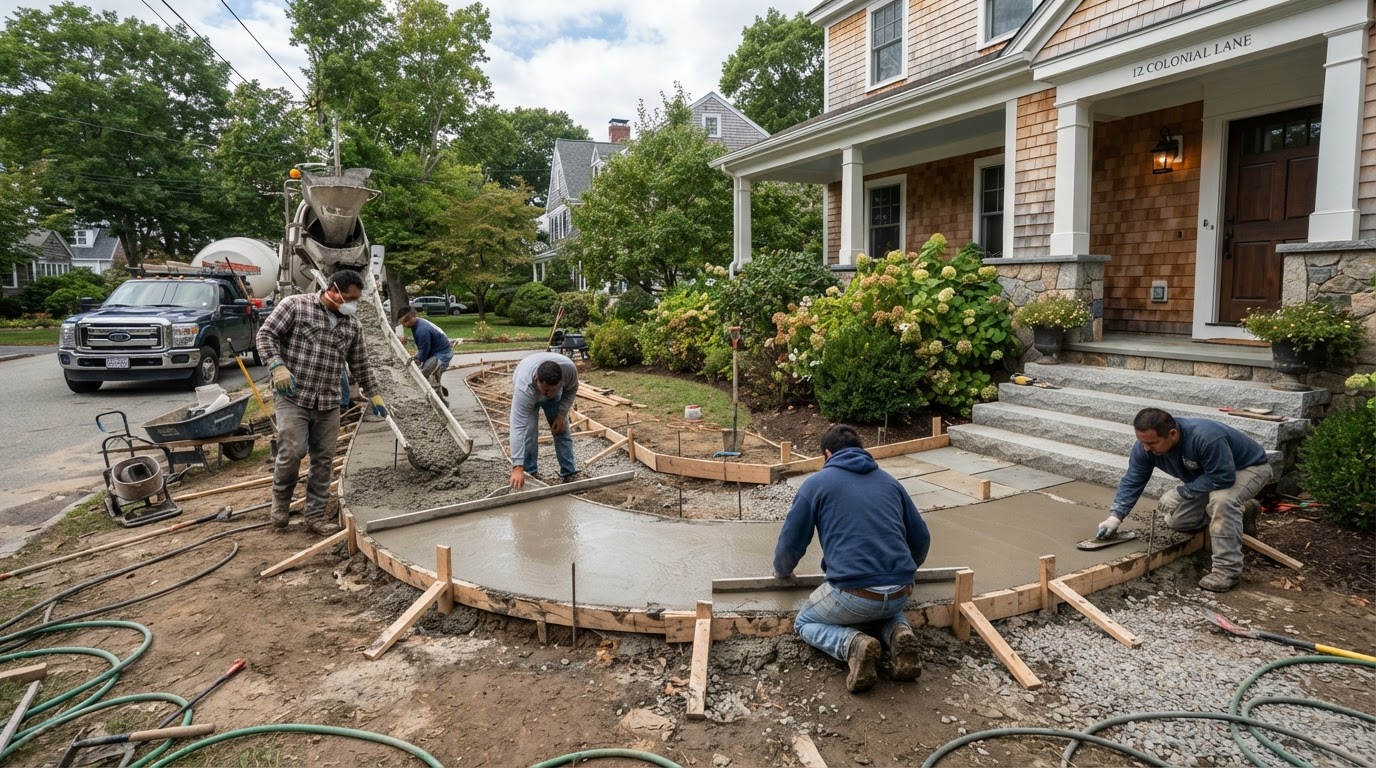
Concrete Sidewalks in Milford, MA | 10+ Years Experience
Milford Masonry Pros installs and replaces private residential concrete sidewalks and pedestrian flatwork in Milford, Massachusetts. With 10+ years of hands-on experience and insured service, we build walkway surfaces that handle foot traffic, freeze-thaw cycling, and seasonal movement through New England conditions.
We focus on entries, side yards, driveway connections, and private-property pedestrian paths — not municipal right-of-way sidewalk work, which involves separate municipal requirements. Sidewalk performance depends on subgrade and base preparation, forming, placement, jointing, pitch and drainage, curing, and clean transitions at entries and driveways. We do not state one universal slab thickness or joint spacing, because the right specification varies with the site and intended use.
Why Choose Milford Masonry Pros for Your Masonry Project?
10+ Years Experience
More than a decade of hands-on concrete sidewalk installation and replacement across Milford and surrounding Massachusetts communities.
Insured
Milford Masonry Pros carries insurance so your property and project are protected while concrete sidewalk work is underway.
Base and Subgrade Focus
We treat the compacted aggregate base and prepared subgrade as the foundation of the sidewalk, because proper base preparation prevents the settlement that fails under-built walkways.
Transition Planning
We plan clean transitions at entries, driveways, steps, and landings so the sidewalk integrates with the surrounding property rather than creating awkward elevation changes.
Freeze-Thaw Awareness
We understand Massachusetts freeze-thaw cycling and deicing salt exposure, and we plan concrete placement, finishing, and curing with those conditions in mind.
Proper Jointing
Control joints and isolation joints are placed to manage cracking and separate the sidewalk from adjacent structures, which is key to long-term flatwork performance.
Transparent Pricing
You see defensible per-square-foot and project ranges up front with the real price drivers named, and a written estimate after evaluation.
Private-Property Clarity
We scope sidewalk work to private residential property and explain when municipal or right-of-way work involves separate requirements, so there are no scope surprises.
Our Specialized Concrete Sidewalk Services
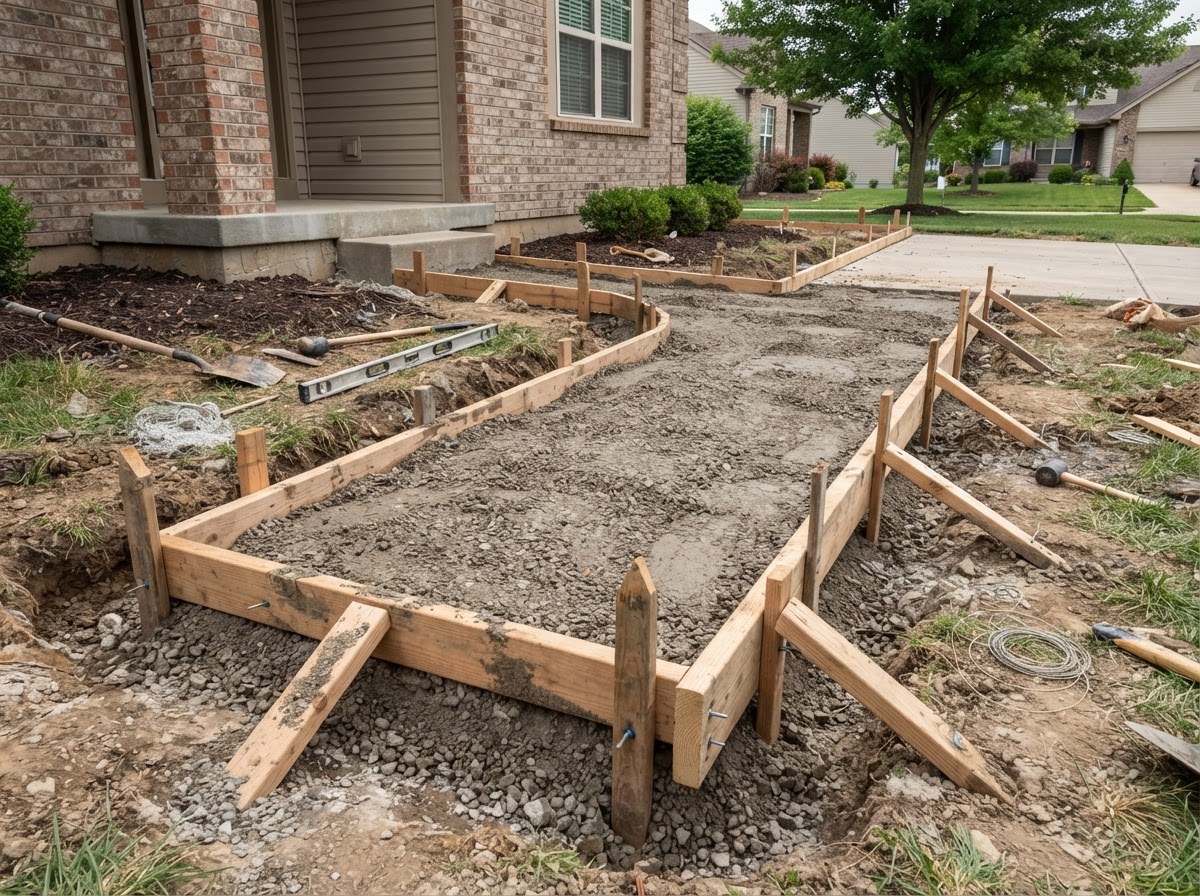
New Residential Concrete Sidewalks
New residential concrete sidewalks build a pedestrian walking surface where none existed or where a new path is being added on private property. It applies to Milford homes where the homeowner wants a durable, low-maintenance walkway connecting entries, yards, driveways, and outdoor-use areas.
Construction involves excavation, subgrade preparation, compacted aggregate base, forms, control joints, isolation joints where applicable, concrete placement, broom finish, pitch for drainage, and curing. The width, route, and transitions are planned to the property and intended use.
A clean pedestrian surface with stable support, controlled joints, and drainage planned into the finished elevations, connecting exterior spaces with a durable walking path.
Concrete Sidewalk Replacement
Concrete sidewalk replacement removes an existing failed sidewalk and installs a new concrete surface in its place. It applies to Milford properties where the existing sidewalk has widespread settlement, cracking, spalling, or deterioration that makes replacement more practical than repair.
The process includes demolition and removal of the existing concrete, evaluation and correction of the subgrade and base, new base preparation, forming, placement, jointing, finishing, and curing. The replacement addresses the conditions that caused the old sidewalk to fail rather than pouring over the same base.
A new concrete sidewalk replaces the failed surface with a properly supported slab, addressing the base and drainage conditions that led to the original deterioration.
Localized Sidewalk Section Replacement
Localized sidewalk section replacement replaces a specific section of the walkway where deterioration is concentrated rather than replacing the entire sidewalk. It applies when one area has settled or cracked while the rest of the sidewalk is still sound.
The work involves removing the failed section, correcting the base or drainage issue beneath it, and pouring new concrete that integrates with the existing sidewalk at a clean joint. The transition between new and existing concrete is planned so the sections align as one walking surface.
The failed section is replaced with a properly supported slab while preserving the sound portions of the sidewalk, addressing the localized problem without a full replacement.
Entry and Driveway Transition Flatwork
Entry and driveway transition flatwork builds the concrete sections that connect a sidewalk to a front entry, side door, or driveway, creating clean, safe transitions between walking surfaces and adjacent areas. It applies where the connection between surfaces needs to be defined or corrected.
The work involves planning the elevation changes, forming the transition sections, placing and finishing concrete with proper pitch and jointing, and integrating the transition with both the sidewalk and the adjacent entry or driveway. Transitions are a common failure point when not properly planned.
A clean, safe transition between the sidewalk and the entry or driveway, with proper elevation changes and drainage that prevents water from pooling at the connection.
Common Causes of Concrete Sidewalk Failure
Settlement
Settlement occurs when the base or subgrade beneath the sidewalk compacts or washes out, causing sections to drop below their original elevation. Settled sections create uneven walking surfaces and trip hazards, and they often indicate that the base was under-prepared or poorly compacted.
Cracking
Cracking in concrete sidewalks results from shrinkage during curing, temperature movement, base settlement, and freeze-thaw stress. Some cracking is normal, but widespread or displaced cracking often points to base, drainage, or jointing problems that warrant replacement.
Spalling
Spalling — where the concrete surface flakes and breaks away — often results from freeze-thaw damage and deicing salt exposure. Massachusetts winters subject sidewalk surfaces to repeated freezing and salt, which can break down an improperly finished or cured surface over time.
Poor Drainage
Poor drainage undermines the sidewalk by allowing water to pool beneath or alongside the slab, weakening the base and subgrade. A sidewalk without proper pitch directs water into the base rather than off the surface, accelerating settlement and cracking.
Deteriorated Transitions
Deteriorated transitions at entries, driveways, and steps create uneven connections between walking surfaces and adjacent areas. When transition sections settle or crack, they create trip hazards and water-collection points that warrant replacement.
Repeated Patch Failure
Repeated patch failure indicates that the sidewalk has deteriorated beyond spot repair. When patches keep failing in the same areas, the underlying base or slab has failed and replacement is typically more durable than continued patching.
Signs You May Need a New or Rebuilt Concrete Sidewalk
Displaced Sections
Displaced sections — where one part of the sidewalk has shifted vertically relative to another — create trip hazards and indicate base or subgrade failure. Displacement warrants evaluation for section or full replacement.
Widespread Breakdown
Widespread breakdown — cracking, spalling, and scaling across most of the sidewalk — means the surface has reached the end of its serviceable life. When the entire sidewalk is failing, replacement is more practical than addressing each defect individually.
Recurring Settlement
Recurring settlement after prior repairs indicates that the base or subgrade continues to fail beneath the sidewalk. When sections keep settling after being leveled or patched, replacement with proper base correction is the right approach.
Drainage Problems
Drainage problems — water pooling on or alongside the sidewalk — indicate that the pitch or grade is not directing water off the surface. Poor drainage accelerates deterioration and warrants replacement with corrected slope.
Unsuitable Existing Layout
An unsuitable existing layout — a sidewalk that no longer connects exterior spaces effectively or has awkward transitions — may warrant replacement to improve the route, width, and connections. A new sidewalk can be planned to fit how the property is actually used.
Our Concrete Sidewalk Process
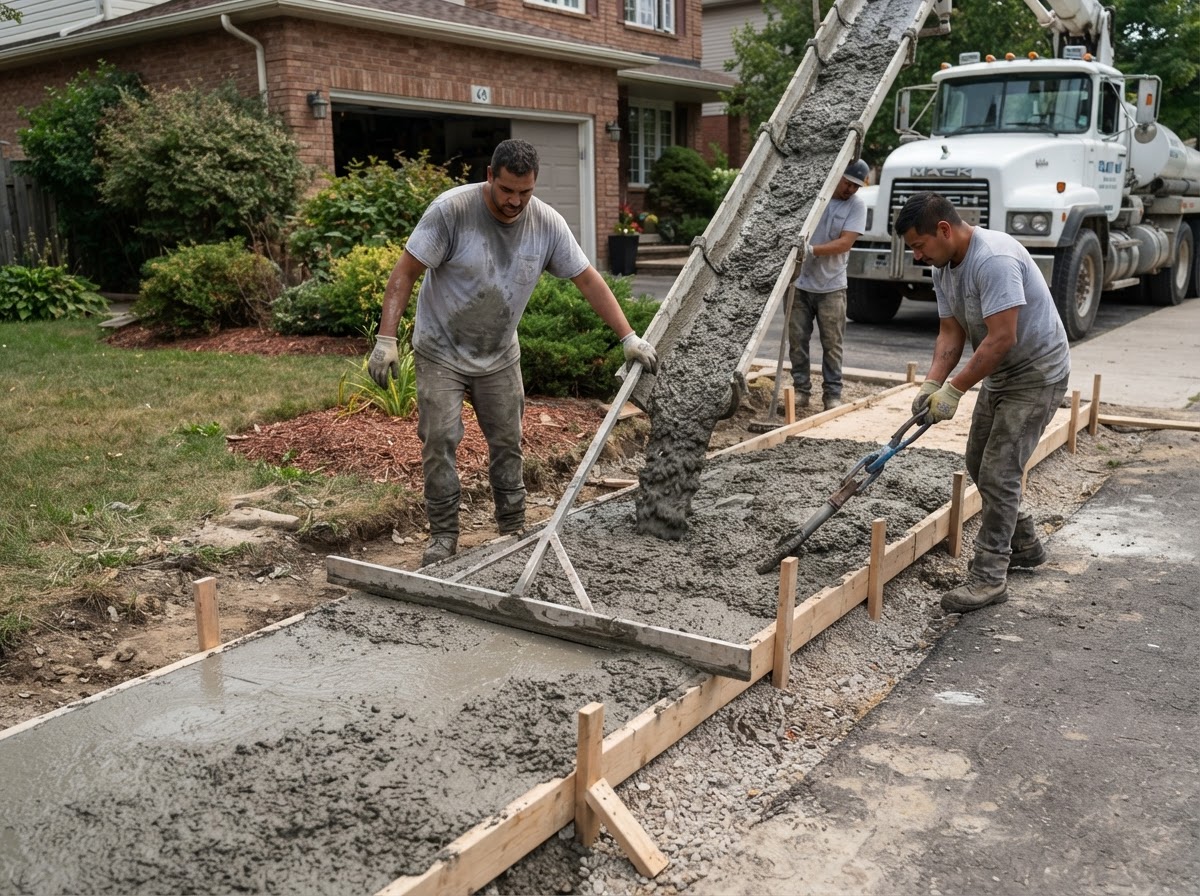
Site and Transition Assessment
We review the sidewalk route, width, grades, entry and driveway transitions, drainage direction, existing concrete, access, and subgrade conditions. The assessment defines the scope, base requirements, and transition details needed for the project.
Removal and Base Preparation
We remove existing concrete when part of the scope, excavate to the required depth, establish the subgrade, and place and compact suitable aggregate base material. The base is prepared to provide uniform support and prevent the settlement that fails under-built sidewalks.
Forms, Placement, and Joints
We set forms and elevations, place the concrete, and plan joint layout with control joints and isolation joints where applicable. The joints are placed to manage cracking as the slab cures and responds to temperature and ground movement, and the surface is finished with a broom texture for slip resistance.
Finishing and Curing
We complete the broom finish, edges, transitions, and drainage pitch, protect the curing concrete as appropriate, and remove project debris. The final walkthrough confirms the sidewalk is properly finished, jointed, and integrated with the surrounding property.
How Much Does a Concrete Sidewalk Cost in Milford, MA?
Concrete sidewalks: commonly about $8 to $18+ per square foot
Notes: Demolition, width, curves, excavation, base, forms, reinforcement where required, access, and transitions affect price.
Small residential sidewalk projects: often about $1,500 to $5,000+
Notes: Fixed mobilization, demolition, base preparation, material, and transition details drive small-project totals.
Replacement with substantial removal and base work: often about $3,000 to $8,000+
Notes: Demolition volume, excavation, base correction, transitions, access, and project length affect the total.
Public or right-of-way sidewalk work: separate scope only if accepted and compliant
Notes: Municipal or right-of-way sidewalk or apron work involves separate municipal requirements and is not automatically included in residential private-property pricing.
Ranges reflect typical Milford-area market conditions and are provided to help you plan. Your written estimate will reflect your specific property, materials, and scope.
Public or right-of-way sidewalk or apron work involves separate municipal requirements and is not automatically included in residential private-property pricing. Ranges reflect typical Milford-area market conditions; your written estimate reflects your specific property and scope.
Get Your Concrete Sidewalk Estimate
Tell us about your Milford-area masonry project and we'll follow up with a clear next step.10+ Years Experience · Insured.
Call 508-458-8256Frequently Asked Questions About Concrete Sidewalks
How much does a concrete sidewalk cost in Milford?
A residential concrete sidewalk in Milford commonly costs about $8 to $18 or more per square foot, with small residential projects often falling between $1,500 and $5,000 and replacement with substantial removal and base work reaching $3,000 to $8,000 or more. Final pricing depends on demolition, width, curves, excavation, base preparation, forms, reinforcement where required, access, and transitions. A site evaluation gives you a defensible written estimate for your specific sidewalk.
Why do concrete sidewalk sections settle?
Concrete sidewalk sections settle when the base or subgrade beneath them compacts, washes out, or shifts over time. Poor base preparation, inadequate compaction, drainage problems, and freeze-thaw movement all contribute to settlement. Settled sections create uneven walking surfaces and often indicate that the base was under-prepared when the sidewalk was installed.
What goes underneath a concrete sidewalk?
A compacted aggregate base over prepared subgrade goes underneath a concrete sidewalk, providing stable, well-drained support for the slab. The base material is compacted to the project specification, and the subgrade is evaluated so the slab has uniform support. Proper base preparation is what prevents the settlement and cracking that fail under-built sidewalks.
Why are joints used in concrete sidewalks?
Joints are used in concrete sidewalks to manage where the slab cracks as it shrinks during curing and responds to temperature and ground movement. Control joints create planned weak points that guide cracking along straight lines, while isolation joints separate the sidewalk from adjacent structures like steps or foundations. Proper jointing is one of the most important factors in preventing random surface cracks.
Can one damaged section be replaced without replacing the whole sidewalk?
One damaged section can often be replaced without replacing the whole sidewalk when the failure is localized and the surrounding sections are still sound. The damaged section is removed, the base is corrected, and new concrete is poured with a clean joint to the existing sections. When multiple sections have failed or the base is compromised throughout, a larger replacement may be more appropriate.
Does concrete sidewalk work require a permit in Milford?
Concrete sidewalk work on private residential property in Milford may or may not require a permit depending on scope and location, while municipal or right-of-way sidewalk work involves separate municipal requirements. Milford Building & Inspections is the applicable local authority for private-property permit questions, and public sidewalk or apron work may require municipal review. We help clarify what applies to your specific project during evaluation.
How do I request a concrete sidewalk estimate?
To request a concrete sidewalk estimate, call 508-458-8256 or submit the estimate form on this page with your name, phone, email, project address, and service request. We review your request, schedule a site evaluation to assess the route, transitions, and existing conditions, and follow up with a clear written estimate and next steps. Either contact method gets you the same process.
Request a Concrete Sidewalk in Milford, MA
Ready to move forward? Call now or send your details and we'll help you take the next step with confidence. 10+ Years Experience · Insured.
Call 508-458-8256Related Masonry Services
Prefer to talk it through? Call 508-458-8256.